


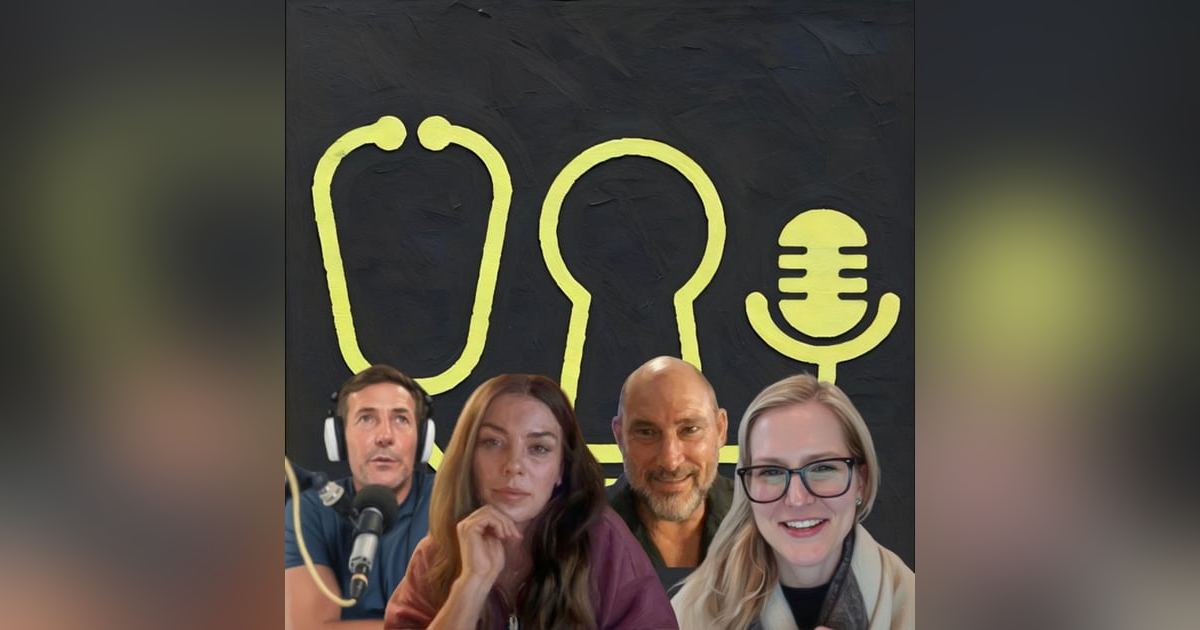
151: Why Do I Still Feel Like Such an Imposter? (This Is What Getting Better Feels Like). With Dr Marie Holowaychuck, Dr Kerri Nelson and Dr Rob Webster


Am I a useless vet?
Sounds like a silly question that a new grad might ask, right? But imposter syndrome doesn't care about your credentials.
It whispers that you're a fraud, that you got lucky, that one day everyone will realise you don’t belong.
Or maybe you don’t feel like an imposter - but you beat yourself up after a case goes wrong. You replay every missed diagnosis. You hold yourself to an impossible standard, and when you fall short (even slightly), the inner critic shows no mercy.
Sound familiar?
In veterinary medicine, where perfection often feels like the baseline and the emotional toll runs deep, these patterns can be exhausting.
But here’s the truth: you’re not the only one who feels this way.
In this raw and honest conversation, we unpack:
- Why imposter syndrome isn’t just a new grad thing - it can resurface anytime you step into something new, no matter how experienced or accomplished you are (Just keep listening if you don’t believe me)
- What confidence really looks like - not knowing everything, but being willing to try, learn, and grow
- Why perfectionism is often at the root of imposter - and what to do about it
- Making peace with the inner-critic
- Why vulnerability matters
- A simple mindset shift that can make all the difference
- And practical strategies to manage imposter feelings
You’ll hear real stories, mindset tools, and the reminder that feeling “useless” says nothing about you.
If you’ve ever questioned your abilities or felt like you're just pretending to hold it all together - this episode is your mirror.
You belong here. And it’s time you believed that too.
Our guests are:
Dr Marie Holowaychuck - a board-certified emergency and critical care veterinarian and the founder of Reviving Vet Med, a global initiative dedicated to equipping veterinary professionals with practical tools for mental health, resilience, and work–life balance, and the author of A Compassionate Calling: What It Really Means to be a Veterinarian.
Check out her new book here.
Dr Kerri Nelson: Experienced ER vet, mentor and former medical director. First time mom-to-be! (She has an epic blog about over-achieving - here.)
Dr Rob Webster: Co-Chief Executive Officer of Animal Emergency Australia, the leading veterinary emergency-care group down under, where he oversees clinical standards and consults on complex emergency and critical-care cases. A board-certified specialist in emergency and critical care since 2014. Jiu-jitsu tragic.
Check out our Advanced Surgery Podcast at cutabove.supercast.com, or go all in on surgery with our collaboration with Sydney University's CVE Surgery Course.
Find out how we can help you build you in your vet career at thevetvault.com.
Get case support from our team of specialists in our Specialist Support Space.
Subscribe to our weekly newsletter here for Hubert's favourite clinical and non-clinical learnings from the week.
Join us in person for our epic adventure CE events at Vets On Tour. (Next up: Japan snow conference!)
Topics and Time stamps
04:28 You're not alone
09:56 What is a syndrome?
15:49 Defining Imposter Syndrome
19:44 Maybe It's Just Kinda Normal?
22:10 So What Can We Do About It?
27:22 The Eternal Internal Critic
30:22 Talk It Out
35:59 Vulnerability As A Weapon Against Imposter
39:03 This Is What Getting Better Feels Like
40:18 Perfectionism - The Root of Imposter
49:28 At Least You'er Not a Psychopath!
51:04 The Best People Are Filled With Self-Doubt
51:56 Mistakes Happen
Imposter Syndrome in Veterinary Medicine: Why It Affects Even the Most Experienced
- Increased Awareness of Knowledge Gaps The longer a veterinarian practices, the more they realize how much they do not know, and the complexity of the field becomes apparent,. When individuals reach higher positions, they realize "wow, there is so much to learn". This recognition that there are "so many things that can go wrong" naturally leads to self-questioning. The thought that one will eventually reach a magical point where they know enough to stop feeling like an imposter is untrue; rather, those who continue learning often recognize the vastness of the unknown,.
- Transitioning into New Roles Imposter syndrome feelings are frequently triggered when an experienced vet moves into a new role, even if they have many years of experience in something else,. For example, a criticalist (a specialist) transitioning into general emergency room (ER) practice may feel unqualified for general cases like itchy dogs or broken toenails, deferring to the general ER team,. Similarly, shifting focus to a new niche or speaking at a conference on a new topic can immediately trigger the fear of incompetence,.
- The Pressure of Perfectionism The veterinary field is often described as perfectionist because it selects for high achievers who have high standards for themselves,. Imposter syndrome is inherently linked to perfectionism. High achievers desire to be perceived as perfect, possessing all the answers, and never making a mistake,. This mentality leads to intense mental health ramifications, including crippling anxiety, depression, and burnout, as failing to meet unrealistic expectations feels debilitating,.
- Paradoxically, the sources suggest that the best people in the profession are often the most self-critical because they can see the potential (their ideal self) the furthest away from where they currently are.
Strategies for Handling Imposter Feelings
- Normalise and Reframe: Acknowledging that the feelings of being nervous, anxious, or doubtful are valid and normal,. Vets are encouraged not to make it personal—it is a temporary "lack of skill" that can be improved, not a lack of "worthiness as a human or as a veterinarian".
- Seek Vulnerability and External Feedback: Talking to someone—whether a partner, mentor, or colleague—is crucial because sharing the experience makes the individual feel less alone,. An external viewpoint helps determine if the internal critic is "justly harsh" or "unjustly harsh". Sharing one's own mistakes and vulnerabilities helps to normalise errors for the whole team and counter the cultural pressure to appear constantly capable.
- Focus on the Evidence and Growth: Vets are advised to look back at their careers, certifications, and successful situations as evidence against the internal critic,. Confidence is redefined as the willingness to try, rather than knowing everything,. The mindset shift of recognizing that "This is what getting better feels like" helps quiet the critic during moments of pressure, fear, or discomfort,,.
- If Necessary, "Crack On": Sometimes the job must get done, and the most immediate strategy is to "put it away" and "just crack on" to get the task finished, addressing the doubts only after the shift,.
- Professional Help: For deeply ingrained perfectionism and thought patterns, the ultimate step may be to seek a mental health professional for deeper work, such as cognitive behavioural therapy (CBT),.
Vulnerability, Mentorship, and Mental Health: The Role of Community and Therapy
The Power of Vulnerability and Community
- Sharing reduces loneliness: Feelings of imposter syndrome can feel "really lonely". Acknowledging that "everybody feels it" is perhaps the "biggest message" to counter this sense of isolation.
- Normalizing mistakes: Sharing personal mistakes and how one learned from them is crucial, particularly for new graduates, as it makes them "feel less alone". This is part of being vulnerable and allows team members to know that "it's OK to make a mistake as long as you learn from it".
- Breaking the cycle of perfectionism: High achievers often struggle with vulnerability because they want to "be perceived in a certain way"—as the person who "knows everything" and "doesn't make a mistake". This inability to admit weakness creates a "cultural thing" in veterinary medicine where people are "very embarrassed to admit weakness, lack of skill, lack of knowledge". Sharing vulnerability acts as a "release" and a "relief" that counters this professional culture.